
Did Earth Have Help Creating Life?
3I-Atlas is an interstellar object that originates from outside our solar system and travels through interstellar space. Interstellar Space is the area of space located between stars within a galaxy. In the case of 3I-Atlas, its origins appear to be from another star system within our Milky Way Galaxy and not from our Solar System. Our Solar System is basically everything that orbits our Sun like planets, asteroids, comets, and other types of icy objects. The distance across our solar system is estimated to be around 18.6 trillion miles.
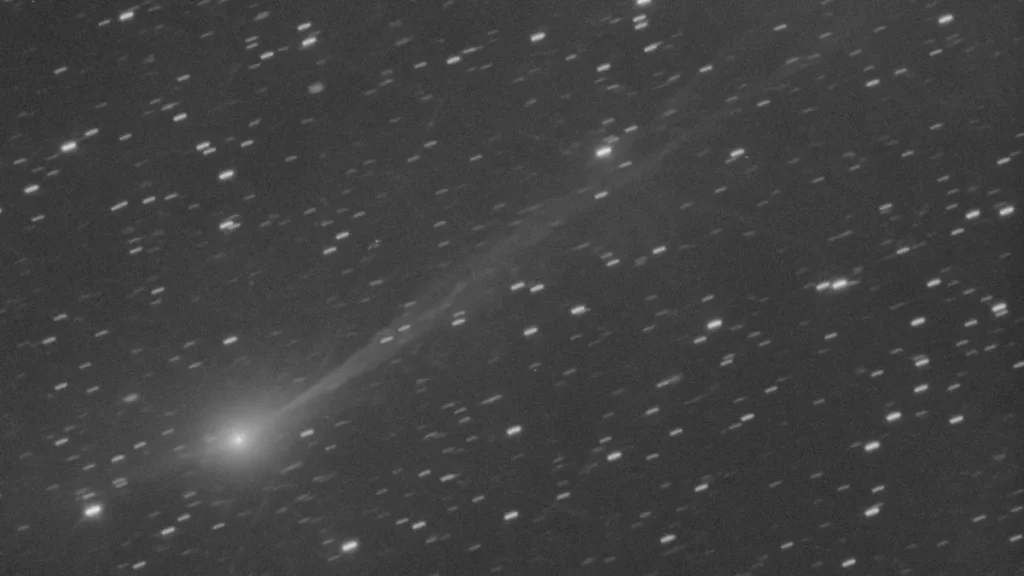
3I/ATLAS captured by astronomer Gianluca Masi on Nov. 19. (Image credit: Gianluca Masi, Virtual Telescope Project)
The interesting thing about 3I-Atlas is, this is the third Interstellar Object that has passed through our Solar System recently. Why is that? Are these objects intelligently controlled or are we just getting in their way. In a couple of previous blogs, I stated our Solar System, which is the official name of our solar system, (not much creativity here) travels around our galaxy at around 514,000 miles per hour. This speed is not precise and depends where and when you research this. I believe it’s not constant either, probably some speeding up and slowing down due to dark energy mass in space and other stuff we’re not aware of. But the point I want to make is, our solar system which is cruising around in our galaxy called, “The Milky Way”, is constantly moving into uncharted space. So, we may just be moving into an area of space which already includes these interstellar objects orbits, you know, getting in their way. The cool thing about this? Scientists can study the make-up of these objects from outside our Solar System by comparing their characteristics to objects in our solar system.
Now here is something to be concerned about, Comets can carry life.
One theory about how life started on our planet is, a comet which carried the building blocks of life like amino acids or some type of organic molecules, crashed into our planet which started a chemical chain-reaction around 4 billion years ago which started life. Now some will say, “God created life on this planet!”.
So, not to be disrespectful to those who think differently than me, I say, “No person on this planet really knows what a God is and exactly how God created life.” Most people can only speculate, and this is based on many factors including beliefs. Now why would I say this?
Because to truly know what a God is and how a God thinks, one would have to be God! It’s that simple.
As a UFO investigator I get frustrated with a lot of people out there who say they know how an Alien thinks. Majority have no idea; it’s just based on their assumption or perception.
So, to know how an Alien thinks, one would have to be an Alien or at least have communicated with one and fully understands. Maybe those who worked at Dulce or S4 for example might have a clue, but I know there’s people out there who know, but most people really don’t.
With God, some people talk to God, some say God answers back, but nobody knows how God came to be and there is much debate and confusion on how God created life. So, not to get wrapped up in the how and why we exist, let’s just look at another possibility of the step in the creation process.
I’m going to suggest that maybe the stepping-stones to create life on this planet came from outer space. And yes, that could have been God’s intention too! Why? Because we are not the only living species in space and we definitely are not the oldest. We probably fall into one of the youngest intelligent species that exist in the cosmos. There is an infinite number of intelligent life forms existing minus some variable and this is based on what we humans know so far in our current scientific studies. As we get smarter and more technologically advanced, we’ll learn more about ours and others existence.
Recently an article in Space.com stated, Earth moss spores were exposed to space for nine months, survived the harsh environment and were able to survive when they returned to earth. Most living organisms can’t survive in the vacuum of space, but the study’s leading author, Tomomichi Fujita, of Hokkaido University in Japan said;
“However, the moss spores retained their vitality after nine months of direct exposure. This provides striking evidence that the life that has evolved on Earth possesses, at the cellular level, intrinsic mechanisms to endure the conditions of space.”
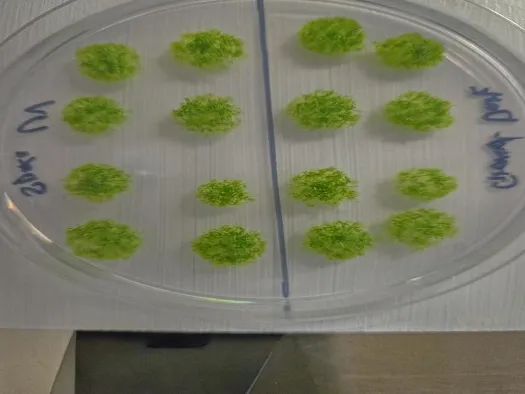
(Image credit: Dr. Chang-hyun Maeng and Maika Kobayashi)
These researchers sent some “sporophytes” (multicellular stage of life of plants), to the International Space Station. Astronauts at the station attached the samples to the station’s exterior, where they remained for 283 days soaking up the elements of space. After that, they returned to Earth on a Dragon cargo capsule in January of 2023. The researchers were surprised to see the moss spores had not died but survived in space. More than 80% of the sporophytes were still alive and 89% of those that survived were able to germinate back in the lab. This showed them the extraordinary durability of these Earth plant cells.
We have absolute proof that some Earth based plant spores can survive in space so one can conclude that other planet’s plant-based spores could also survive in space. Maybe survive by hitching a ride on an asteroid or comet?
Scenario 1:
An asteroid skims the surface of some unknown planet and breaks up. Some of the remaining pieces bounce back into space and start a new journey. But while scraping the surface these pieces pick up some of that planet’s vegetation and are embedded in the asteroid. Continuing through space the asteroid ultimately strikes another planet. The vegetation or spores which were embedded in the asteroid are now released and exposed to the atmosphere of the new planet. Depending on the evolutionary period of this planet, the spores might be able to germinate in the new atmosphere. Thus, life has started.
Scenario 2:
Same conclusion as scenario 1, but the asteroid doesn’t skim the planet but impacts it. Hit’s it so hard that portions of the planet’s surface are ejected into space. The ejected materials contain vegetation thus the possibility of ejected materials could impact other planets and start life.
Scenario 3:
Intelligent seeding: An intelligent species creates an artificial asteroid which contains many variations of life that can sustain the elements of space. Using bio-engineering the asteroid has a mission to seed other planets it may encounter through its journey by simply releasing some of its structure to impact desirable planets.
Some seem to think 3I-Atlas could be an intelligent asteroid, comet or even an interstellar spaceship. Some of its movements are unusual compared to other asteroids or comets which is currently being debated. If it’s a biological probe-type asteroid and some type of technology is attached to it, then the technology could use the elements of the asteroid or comet to control its protectory by simply releasing gases during its flight.
What if 3I-Atlas is an Ark-type asteroid containing elements for life? If it has some type of alien technology attached to it, this will allow it to buzz through the interstellar cosmos looking for those planets that are suitable for life. Then when it spots one, it seeds it. What if this ark-type asteroid contains not vegetation but stored biological life too! Then this would be a true Noah’s Ark designed to populate a planet with maybe a dying species or something entirely different.
NASA believes 3I-Atlas is a natural comet from another star system with very unique properties. It could be coming from a system a lot older than ours but much still needs to be learned. They believe it’s primarily made of rock and ice, with an unusual abundance of nickel and lots of carbon dioxide and water. Carbon dioxide and water are building blocks for photosynthesis in plants, so maybe there are also plant spores attached to it too?
Could a comet like 3I-Atlas from an outside star system have hit our planet at exactly the right stage of our evolutionary cycle to start life as we know it? It’s possible, so far, we are really only guessing how life started here but it could have had a jump start.
As for intelligent intervention purposely starting life on this planet, maybe, but why? Could there be an alien race out there who has already projected when their planet’s resources will dimmish, so they came up with an idea to create an identical planet they could move to eventually?
Some think this idea is crazy, yet others not so much. Could we merely be caretakers for a custom-designed planet? Which means our planet is already spoken for? Which means, we may get visitors in the future?
I personally lean on the comet or asteroid impact theory which would prove my point that life exists everywhere in the cosmos. And for those who believe God started life on this planet, well maybe that’s how God did it.
Chuck Zukowski
Category: The Z-Files


